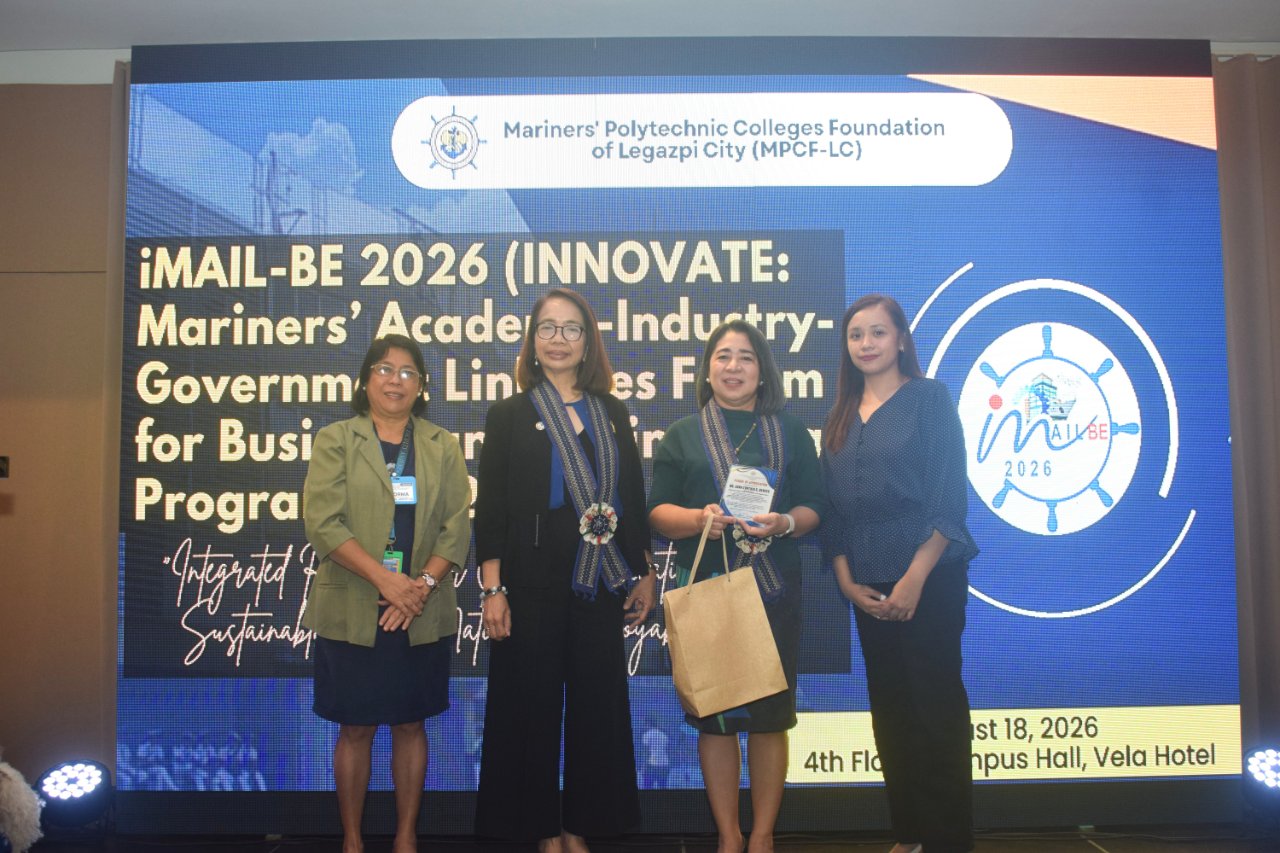
Mariners’ Polytechnic Colleges Foundation of Legazpi City (MPCF-LC) convened representatives from government, industry, and higher education on August 18, 2026 for iMAIL-BE 2026, a forum aimed at aligning its business and engineering programs with regional development priorities and changing workforce requirements.
Held at The Vela Hotel in Legazpi City, the INNOVATE: Mariners’ Academe-Industry-Government Linkages Forum for Business and Engineering Programs 2026 carried the theme “Integrated Response for Quality Education and Sustainable Local/National Employability.” MPCF-LC President Ms. Merle Jimenez-San Pedro, FRIM said the institution continues to strengthen the connection between classroom instruction and workplace requirements.
“Education becomes more meaningful when what we teach is connected to the realities of the workplace. Through iMAIL-BE, we are strengthening that connection so our students can graduate not only with a diploma, but with the competencies, adaptability, and confidence that industry expects.”
The opening program included remarks from Ms. Norma M. Villanueva, OIC-Vice President for Academic Affairs, and Ms. Chona Gallas, SIPP Coordinator. Legazpi City Mayor Ismail Hisham, through a representative, also delivered a special message.
The morning sessions focused on workforce trends and the skills required by local and regional industries.
Asst. Director Jasmin C. Zantua, Assistant Regional Director of the Department of Economy, Planning, and Development V, discussed industry demands and opportunities under the Regional Development Plan.
“Preparing a future-ready workforce requires us to look beyond the jobs available today. We need to anticipate where the regional economy is heading and make sure that education, training, and skills development are aligned with those emerging opportunities.” Zantua said. Mr. Victor Emmanuel S. Castro, BDD Division Chief of the Department of Trade and Industry V, meanwhile discussed industry opportunities and critical skill requirements in Albay’s priority sectors.
“The challenge is not simply to create employment opportunities, but to ensure that our workforce has the right skills to take advantage of them. Industry requirements continue to evolve, and our graduates must be prepared to evolve with them,” Castro said. At the city level, Ms. Jocelyn M. Codorniz of the Legazpi City Planning and Development Office discussed workforce needs in Legazpi’s priority sectors.
“When schools understand the direction of local development and prepare students according to the needs of priority sectors, education becomes a direct partner in economic progress,” Codorniz said.
Representing the private sector, Mr. John Glenn C. Lee, President of the Albay Chamber of Commerce, Inc., discussed the business landscape of Albay and the competencies employers expect from graduates.
“Employers are looking for more than academic credentials. We need graduates who can communicate, solve problems, adapt quickly, work with people, and apply what they have learned in real workplace situations,”Lee said.
The forum also featured Dr. Demetrio P. Anduyan, Jr., CESO III, Regional Director of the Commission on Higher Education V, who discussed microcredentials, Philippine Qualifications Framework alignment, and stackable career pathways.
“Higher education must become more flexible and responsive to the changing world of work. Microcredentials, stackable qualifications, and pathways aligned with the Philippine Qualifications Framework can give learners more opportunities to continuously build competencies throughout their careers,”Anduyan said.
In the afternoon, MPCF-LC presented its programs in Hospitality Management, Customs Administration, Mechanical Engineering, and Tourism Management, followed by parallel round-table discussions on the institution’s Career Pathways Program.
The discussions provided government and industry representatives an opportunity to give inputs on how the programs could be further aligned with employment requirements. An open forum followed, along with the presentation of updated career pathways and the status of memoranda of agreement with institutional partners.
The program concluded with a synthesis by Dr. Nila Oñate, MPCF-LC Consultant, and closing remarks from Engr. Joel P. Sadol, ORES Director.
Through iMAIL-BE 2026, MPCF-LC sought to strengthen cooperation among the academe, government, and industry while using stakeholder inputs to improve academic programs and prepare graduates for employment opportunities in Albay, the Bicol Region, and the broader labor market.